
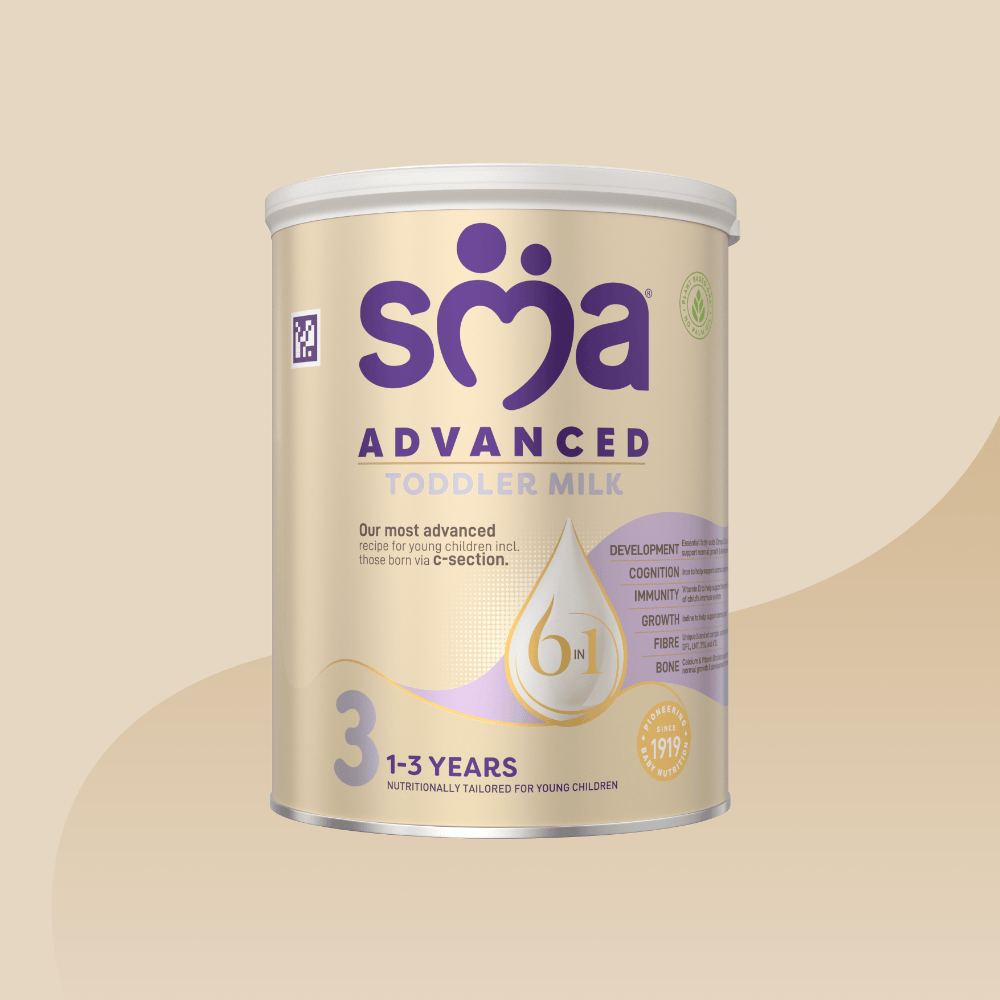
SMA® ADVANCED Toddler Milk
Nutritionally tailored for young children aged 1 to 3 years, including those born via c-section.
A fortified milk drink suitable for toddlers as part of a varied and balanced diet. SMA® ADVANCED Toddler Milk contains our unique blend of multi - fibres - 2’FL, DFL, LNT, 3’SL, 6’SL & 3’FL which has been shown to promote a healthy gut microbiome.1
Data cards
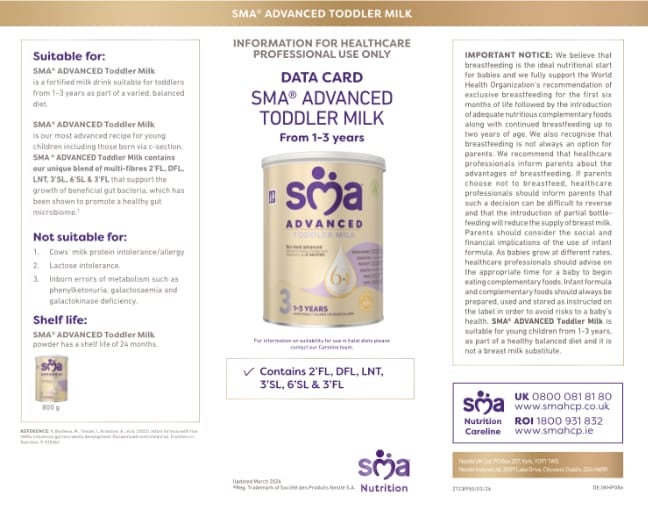
Download the powder format data card
Product details
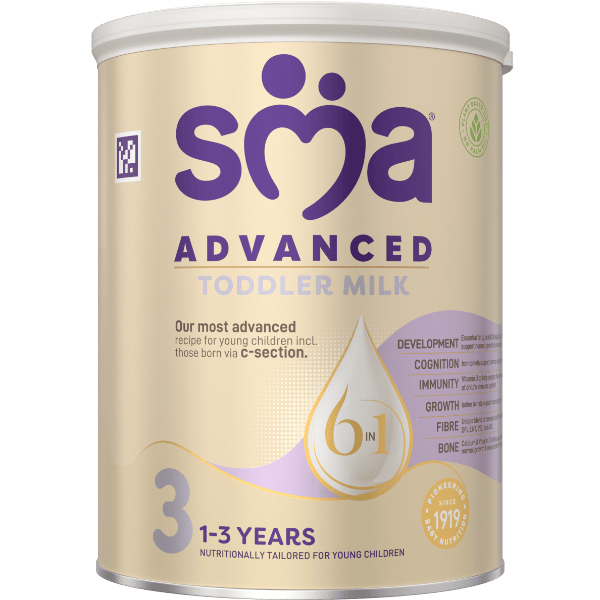
SMA® ADVANCED Toddler Milk Powder Formula
800g Powder
The scoop is provided under the lid. It can be stored in suspension inside the can.
Feeding guide from 1 to 3 years
| 1 serving = 200 ml | Amount of cooled, freshly boiled water | Number of scoops of powder | |
|---|---|---|---|
| 1 beaker | 180 ml | 6fl. oz. (approx). | 6 |
This table is a guide only. All toddlers are different. After 12 months, we recommend giving your child around 400 ml of milk drink per day. Mix 1 scoop of powder to 30 ml (approx. 1 fl. oz.) of water. Approx. 173 scoops per can. 1 scoop = 4.6 g. Approx. 29 x 200 ml servings per can.
- Do not add extra powder or water to make the milk drinks stronger or weaker and do not press powder into scoop. Using too much or too little powder can make your toddler ill.
- We recommend preparing each milk drink in individual beakers when required.
- For hygienic reasons, discard unfinished milk drink in the beaker as soon as possible.
- Made-up milk drink can be poured over cereals and mixed with food.
- Do not alter or add to milk drink unless medically directed.
- Do not warm milk drinks in a microwave, hot spots may occur and cause scalding.
Preparation
How to prepare the toddler's feed - powder
While this product is made under strict hygienic conditions, it is not sterile. Failure to follow instructions may make the toddler ill.

1
Wash hands well.

2
Measure 180 ml (approx. 6 fl. oz.) of cooled boiled water into a clean beaker.

3
Using only the scoop provided, add 6 scoops of powder, levelling off each scoop with the back of a clean dry knife. Store the scoop in suspension inside the can and replace lid.
4
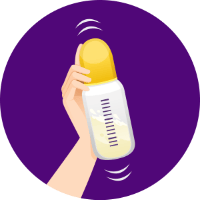
Place a lid on the beaker and shake well until powder is fully dissolved. Cool beaker under cold running water or in a bowl or jug of cold water until lukewarm, do not immerse the lid. Test temperature by shaking a few drops on to the inside of your wrist.
- Bosheva, M., Tokodi, I., Krasnow, A., Pedersen, H. K., Lukjancenko, O., Eklund, A. C., Grathwohl, D., Sprenger, N., Berger, B., Cercamondi, C. I., & 5 HMO Study Investigator Consortium (2022). Infant Formula With a Specific Blend of Five Human Milk Oligosaccharides Drives the Gut Microbiota Development and Improves Gut Maturation Markers: A Randomized Controlled Trial. Frontiers in nutrition, 9, 920362. https://doi.org/10.3389/fnut.2022.920362
- EFSA Panel on Dietetic Products, Nutrition and Allergies (NDA). (2014). Scientific Opinion on the substantiation of a health claim related to zinc and normal function of the immune system pursuant to Article 14 of Regulation (EC) No 1924/2006. EFSA Journal, 12(5), 3653.
- Mora J, et al. Vitamin Effects on the Immune System: Vitamins A and D Take Centre Stage Nat Rev Immunol 2008; 8(9): 685–98.
- EFSA Panel on Dietetic Products, Nutrition and Allergies (NDA). (2015). Vitamin C and contribution to the normal function of the immune system: evaluation of a health claim pursuant to Article 14 of Regulation (EC) No 1924/2006. EFSA Journal, 13(11), 4298.
- SACN_Vitamin_D_and_Health_report.pdf (publishing.service.gov.uk)
- Gibson S & Sidnell A. Nutrient adequacy and imbalance among young children aged 1–3 years in the UK. Nutrition Bulletin 2014; 39: 172–80.
IMPORTANT NOTICE:
We believe that breastfeeding is the ideal nutritional start for babies and we fully support the World Health Organization’s recommendation of exclusive breastfeeding for the first six months of life followed by the introduction of adequate nutritious complementary foods along with continued breastfeeding up to two years of age. We also recognise that breastfeeding is not always an option for parents. We recommend that healthcare professionals inform parents about the advantages of breastfeeding. If parents choose not to breastfeed, healthcare professionals should inform parents that such a decision can be difficult to reverse and that the introduction of partial bottle-feeding will reduce the supply of breast milk. Parents should consider the social and financial implications of the use of infant formula. As babies grow at different rates, healthcare professionals should advise on the appropriate time for a baby to begin eating complementary foods. Infant formula and complementary foods should always be prepared, used and stored as instructed on the label in order to avoid risks to a baby’s health. SMA® ADVANCED Toddler Milk is suitable for young children from 1-3 years, as part of a varied balanced diet and it is not a breast milk substitute.